PIONERI

CURATORIAL PLATFORM OF EMERGING FINE ARTISTS

Kaja Tasevska in Capri at the Lost Artists Residency

February 4, 2026
pioneri

We admire her insatiable curiosity and strong academic background.

Kaja Tasevska holds a Bachelor of Arts in Media, Art, Design, and Architecture, with a specialization in Architecture from Vrije Universiteit Amsterdam (2022–2025). She is currently enrolled in a Pre-Master’s programme in Architecture at Eindhoven University of Technology and plans to begin the Master’s programme in Architecture in the next academic semester. Alongside her academic studies, she is studying within the Professional Photography (online) programme at the New York Institute of Photography.

P: How does your architectural knowledge influence your work as a photographer and curator? Conversely, how does your background in art and photography contribute to becoming a better architect?

K: My architectural training and my work as a photographer and curator constantly inform each other. Architecture has taught me to see space as something constructed through proportion, sequence, material, and atmosphere, rather than as a neutral backdrop. When I photograph, I’m not just capturing a moment, but composing spatial relationships: how elements sit in the frame, how light moves, and how people occupy space.

That way of thinking also shapes how I curate. I approach exhibitions as spatial narratives, thinking about how images relate to one another, how a viewer moves through them, and where moments of pause or contrast happen.

At the same time, photography feeds directly back into how I think about architecture. It has trained me to pay attention to atmosphere and lived experience – how spaces are actually used, how light changes over time, and how materials age. It pushes me to think beyond buildings as purely formal or technical objects and to see them more as cultural and emotional environments.

Photography also made me very aware of representation: that architecture exists not only as something built, but also as something seen, shared, and remembered. For me, the two practices aren’t separate – they’re one continuous way of thinking about space, from observing and framing it to designing and constructing it.

Cultivating Landscape’, ©️arhitektura nova part of the biennial architectural exhibition ‘Time Space Existence’ Venice, 2025
Cultivating Landscape’, ©️arhitektura nova
part of the biennial architectural exhibition ‘Time Space Existence’ Venice, 2025

P: You recently took part in the ten-day Lost Artists residency on Capri, led by photographer Davide Esposito.
What stayed with you from this experience?

K: What stayed with me from the residency was the way technical limitations and personal introspection became inseparable. By working within strict constraints, whether through medium, technique, or process, I had to let go of many of the rules I had built around my photography. My work has often been driven by clarity, control, visual order, and rhythm, but the residency disrupted that comfort. Within those limits, imperfections began to surface, and instead of correcting them, I was encouraged to stay with them and understand what they were revealing.

The individual sessions with Davide Esposito deepened this process in an unexpected way. Together, we revisited my past photographic work and unpacked the symbolism behind it, looking closely at why certain visual structures, repetitions, and absences kept appearing. These conversations shifted my understanding of authorship: my stylistic choices were no longer just aesthetic decisions, but expressions of mindset, psychology, and self-protection. For the first time, I began to see my photography as a trace of how I relate to order, uncertainty, and vulnerability.

What made the experience unique was how these personal reflections directly fed back into the act of making images. The technical constraints were no longer neutral exercises; they became tools for self-inquiry. Experimentation stopped being about searching for a new style and became a way of testing how far I could allow myself to move beyond what felt familiar, “correct,” or “perfect.” This reframed my relationship to practice itself from something outcome-driven to something rooted in awareness and honesty.

I left the residency with a clearer understanding that the development of a photographic practice is not linear or stylistic, but psychological and experiential. The photos I make now feel less about maintaining control and more about allowing space for intuition, contradiction, and growth. In that sense, the residency did not simply influence my work – it reshaped how I understand the relationship between who I am and what I create.

International Competition: 1st Prize for the conceptual design of the Athletic Stadium in Podgorica, ©️arhitektura nova

P: Do you have curatorial experience beyond your university practice?
Are you currently exhibiting your photographs, or have you recently shown them in any notable context?

K: Yes, my curatorial experience extends well beyond my university practice. I’ve curated two solo exhibitions, both of which required me to think critically about selection, sequencing, and spatial narrative. My first solo exhibition, Visual Journey, took place in Breisach, Germany, in May 2023. It included around fifty photographs and was my first large public presentation of my work. The exhibition brought together a wide range of genres – portraiture, landscape, travel, street, abstraction, animals, and black-and-white photography – which challenged me to create coherence across very different bodies of work and to curate them into a readable visual journey rather than isolated images.

My second solo exhibition, Anemoia, took place in Skopje, North Macedonia, in December 2024. This exhibition was more conceptually focused and introspective, exploring nostalgia for times and places never personally experienced. Compared to my first exhibition, Anemoia marked a shift toward a more mature, cohesive practice, where curatorial decisions were closely tied to atmosphere, memory, and emotional continuity rather than variety alone.

Alongside these curatorial projects, my work has been exhibited in several notable contexts. My photograph Daydreaming, has been permanently exhibited at the Austrian Parliament since 2018, following my award as Children’s Peace Image of the Year at the Global Peace Photo Award.

More recently, in the autumn and winter of 2025, I took part in several international exhibitions. I was a semi-finalist at the Head On Photo Festival, where my work was exhibited on Bondi Beach. I also participated in Trieste Photo Days, where my photographs were included in the themed exhibition and publication Urban Animals, organized by Exhibit Around.

Additionally, I was selected by the award-winning Dutch documentary photographer Ilvy Njiokiktjien to take part in a traveling exhibition and contest organized by the Dutch Embassies in the Western Balkans. This project traveled across North Macedonia, Serbia, Albania, Kosovo, and Bosnia and Herzegovina, addressing themes of EU integration, disinformation, and the lived realities of young people in the Western Balkans navigating competing narratives around Europe and identity.
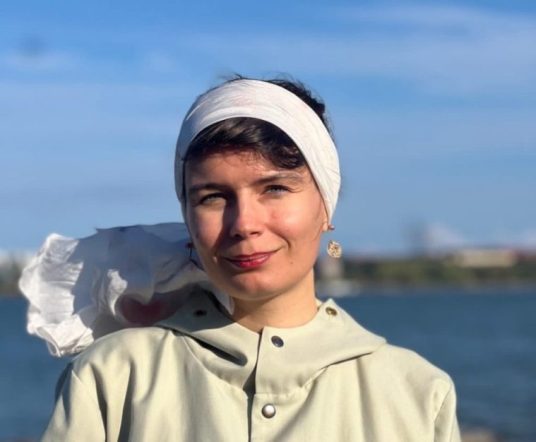
P: How are you currently balancing work and study?

K: At the moment, I’m balancing my studies alongside starting work next week at Wonderland Impact Investments, a company focused on impact-driven development and adaptive reuse of existing buildings. My role combines architectural research with marketing, which allows me to work across analysis, storytelling, and visual communication, bringing together architecture and photography in a very natural way.

In terms of balance, I’m very conscious about structure and boundaries. My studies remain my priority, so I’ve been intentional about taking on work that directly supports and enriches what I’m already doing academically and creatively. Photography continues to function both as a professional tool within my work and as a personal practice alongside it, rather than as something separate competing for time.

For me, the balance comes from alignment rather than separation – choosing roles and projects that speak to the same interests, so work, study, and photography feed into one another instead of pulling in different directions.