PIONERI

CURATORIAL PLATFORM OF EMERGING FINE ARTISTS

Pioneri Weekend Chats w/ Vitja Bogdanova

August 18, 2025
pioneri

From award-winning architect to visual poem artist, and postdoctoral researcher— we had the pleasure of speaking with Vitja Bogdanova about her latest achievements during her time in Helsinki.

P: Two months ago, you participated in the Venice Biennale in the European Culture section together with a group of architects. What artistic project did you present, and in which building was it displayed? We are really curious to hear all about it!

V: The exhibition was a sculpture that represented an imaginary chronological section of different houses and their topographies of the architectural studio arhitektura nova, founded by Marija Dimitrievska Cilakova. I was immensely glad to be a participate in that magic with a very modest contribution. I experience the sculpture as a spatial storytelling of the loving dialogue between the site and the site-specific design of their projects. Some of them are built, others are in the process of becoming. The exhibition is inside Palazzo Mora, in a room holding a Tiepolo fresco on the ceiling, with a wooden framing around it. The sculpture was accompanied by an art book that visualised the concept of the installation in an imaginary, extended format through the whole palace, a labyrinthal creature that manifests a sensitivity not only to the territories / topographies that hold the various housing units, but also a sensitivity to the Palace as a place of exhibiting.

Cultivating Landscape’, ©️arhitektura nova part of the biennial architectural exhibition ‘Time Space Existence’ Venice, 2025
Cultivating Landscape’, ©️arhitektura nova
part of the biennial architectural exhibition ‘Time Space Existence’ Venice, 2025

P: Even more remarkable is that you were part of the all-female team that won first prize in the international competition for the conceptual design of the Athlete Sports Centre in Montenegro. What makes this project particularly striking is the open design of the stadium, which connects it to the city instead of enclosing it. Could you tell us more about the concept and how your team approached it?

V: Again, this project was being created within the energy of arhitektura nova. I will try to answer to it by the introductory abstract we had on the first page of the booklet (you can read the whole story on the link): 

A gentle topography,
a  calming wave rising
from the body of the land
into a strong architectural presence:
a solid infrastructure
embraced by a forest.

Contrary to the stereotyped sport fortress
surrounded by defensive walls,
this stadium is a wholly open structure,
not a fortress to be conquered,
but a meadow
embraced by a promenade,
a gentle continuation of the landscape
serving the community as a
radical spatial democracy,

an infrastructure of
active leisure and free time,
a building to be intensely
used and inhabited,
celebrating wellbeing
as a culture of everyday life,
a home out of home,
a place of cultivating calmness
and daydreaming of new horizons.

The stadium is a solid architecture
a platform of leisure research,
a nucleus
articulating the surrounding forest,
an embodiment of a loving encounter
between nature and architecture.

International Competition: 1st Prize for the conceptual design of the Athletic Stadium in Podgorica, ©️arhitektura nova

3. P: “Mapping” is a recurring process in your work,  present both in your artworks, and Archi Contemplatives workshops, as well as in your postdoctoral research exploring historical maps. How do your artworks evolve within this process, and in what ways does your research influence your artistic expression?

V: Within the frame of the Archi Contemplatives workshops, I mainly worked with people from different countries, most of them visually sensitive: architects, artists, urban designers, textile artists, or geographers. We worked with urban storytelling, experimented with implementing embodied knowledge into design projects. Maps worked as a means of self-investigation. We were mapping what we remember from walks, mapping how we organise design decisions, mapping how we make sense of the creative process. Maps served as a continuous zooming in and out of the creative process. They were modalities of reflective understanding of one’s own practice, from a fresh perspective.

Within the frame of the two projects I have been working on so far as a postdoctoral researcher, “Creativity and Well-Being” and “Mapping Environmental Crises Through the Lenses of Myths and Sciences, at the Aalto Visual Communications Design Group, we were mainly interested in how people who are not necessarily visual persons make sense of the world, by mapping it between drawings and words. In our workshops, we are trying to understand what becomes meaningful enough to a person, meaningful enough so that she or he puts that entity or experience on a drawing. We are explicit that the drawings do not need to be beautiful in the traditional sense. We ask people to imagine they are writing a visual letter to a beloved one. Then, they take the task more seriously in an emotional context, and in a more relaxed way in the technical sense: they stop caring how it looks like when they realize the people around them are more interested to hear their story, rather than their technical skills in drawing. We have just published a paper on one of the workshops, you can read the full piece here.

I think mapping is one of the most essentials processes in my life. Mapping emotions, mapping words, mapping verses, mapping processes, mapping plans, mapping past adventures, mapping walks, mapping heroes, mapping books. Facilitating a workshop, teaching or mapping on my own: these are all different modalities of finding and sharing myself with the world and with others, encountering meaningful others and sharing with them what I find most essential to me in the particular moment. This is when I feel most alive, and most grateful for being alive.
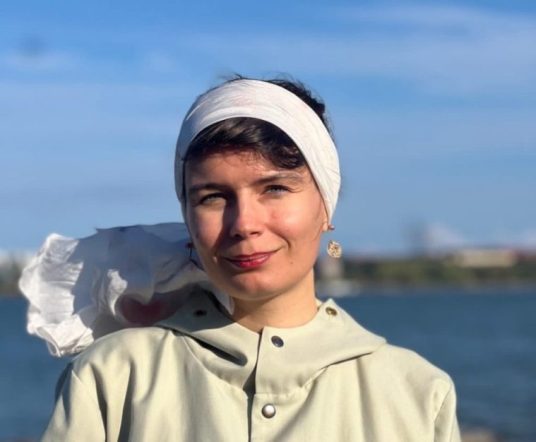
P: We enjoy reading and admiring your poetic drawings, feeling the effortless calmness they emanate. Would you share a drawing or a poem that you have loved recently?

V: Thank you! Not ready to share my new ones yet, but I can share a poem that filled my heart just a week ago, the best verses thing I have read in months:

Francisco de Quevedo, Love That Endures Beyond Death, both in Spanish original and English translation.

Francisco de Quevedo:

Amor constante más allá de la muerte

Cerrar podrá mis ojos la postrera 
sombra que me llevare el blanco día,
y podrá desatar esta alma mía
hora a su afán ansioso lisonjera;

mas no, de esotra parte, en la ribera,
dejará la memoria, en donde ardía:
nadar sabe mi llama la agua fría,
y perder el respeto a ley severa.

Alma a quien todo un dios prisión ha sido,
venas que humor a tanto fuego han dado,
médulas que han gloriosamente ardido:

su cuerpo dejará, no su cuidado;
serán ceniza, mas tendrá sentido;
polvo serán, mas polvo enamorado.

Francisco de Quevedo:

Amor constante más allá de la muerte

When the last shadow comes to douse the white
radiance of day, it well may close my eyes;
it may unbind my soul, so that it flies
free, toward its eager wish, full of delight;

but soul will not abandon in its flight
memory, where it burned: my flame is wise,
knows how to swim the icy stream, and rise
to disobey the law more stern than right.

My soul, for whom the cell god’s will has been;
veins that have, for so long, nurtured such fire;
my very core, gloriously lit within,

will let the body go, but not desire;
will be ashes, but sentient as when skin;
will be dust, but dust in love upon the pyre.